Aresident OpenClaw Gatewayis the piece that keeps agents, channels, and your control UI online when laptops sleep and demos end. In 2026 the real decision is not “npm or Docker in the abstract,” butwhich Mac-shaped computeranchors that process: hardware you own in one city, orcloud Macs in multiple regionsthat you can spin up beside users and CI. This FAQ walks through the trade-off, the two mainstream install paths (official shell installer versusnpm install -g), the errors that show up in real tickets, and what business teams should document before they call a gateway “production.”

Buy a Mac vs rent multi-region cloud Macs
Buyingwins when you already amortize deskside Macs, you have spare power and cooling, and latency to a single metro is “good enough.” You control firmware timing, but you also ownracks, UPS, remote hands,and the security story when someone must physically reboot after a kernel panic.
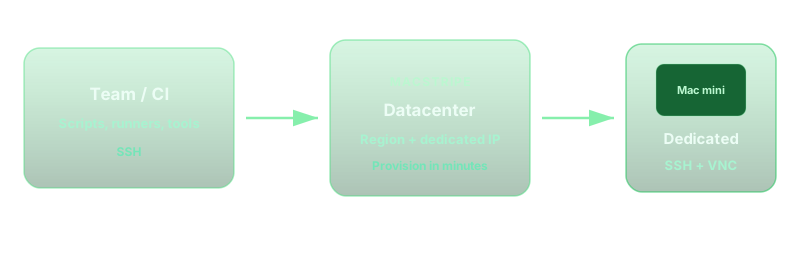
Renting dedicated cloud Macswins when you needthe same bare-metal shape in more than one region, you want a fresh SSD image per engagement, or finance prefers opex without a three-year CapEx line for metal. For OpenClaw, the extra benefit is practical: park the gateway next to the same network path your model APIs and chat webhooks already use, then measure round trips instead of guessing from a home office ISP.
Official installer vs npm global install
OpenClaw ships multiple entry points; teams usually pick one of two.
Thecurl-to-bash style installerpublished on the OpenClaw site wires up prerequisites, drops the CLI on disk, and can hand you straight into onboarding. It is attractive when you are SSH’d into a fresh host and want fewer manual steps—justverify the exact URL on the official docsbefore you paste anything into production jump boxes.
Thenpm pathlooks likenpm install -g openclaw@latest(or a pinned version once you trust the release). It fits teams that already standardize Node withnvmorasdf, want the binary in a known prefix, and plan to upgrade with the same automation they use for other CLIs. After install, most guides converge onopenclaw onboard --install-daemonso LaunchAgent or systemd-style supervision survives logout and reboot.
From there you still decide how to package the rest of the stack. If you are co-locating workers with Compose, pair this article with our walkthrough on image pinning and gateway health checks: OpenClaw Docker Compose in 2026: deployment and troubleshooting.
Typical errors teams see first
Node too old or wrong architecture.Install docs move faster than LTS blog posts—treatnode --versionandprocess.archas gate checks. Apple Silicon hosts should run an arm64 Node build; Rosetta-mixed trees are a common source of “works on my laptop” drift.
openclaw: command not foundafter npm.Almost always PATH: runnpm prefix -g, append itsbindirectory to your shell profile, reload the shell, and re-test. Avoidsudo npm install -g; prefer a user-owned prefix so upgrades stay repeatable.
Native module failures aroundsharpor libvips.Community runbooks often suggest environment flags such asSHARP_IGNORE_GLOBAL_LIBVIPS=1when prebuilt binaries disagree with the host image. Capture the working export in Ansible or your golden AMI notes so the next rebuild does not rediscover the same compile error.
Gateway up but clients cannot attach.Confirm whether the gateway binds to127.0.0.1only versus a routable interface, whether TLS termination sits in front, and whether tokens inOPENCLAW_GATEWAY_TOKENmatch what youropenclaw-nodeclients send. For a deeper instance-and-storage checklist on vpszap itself, see
Running OpenClaw on vpszap Cloud: instances, storage, SSH/VNC, and observability.
Business rollout FAQ
Who owns secrets?API keys belong in a vault or short-lived secret store, not in long-lived shell history. If finance insists on per-project billing, map each gateway to a cost center before you enable high-volume channels.
How do we test failover?Run a scheduled drill: stop the daemon, restore from backup config, replay a canned conversation, and measure time-to-green. If you rely on regional Macs, rehearse moving the gateway hostname between regions instead of assuming DNS magic.
Where does CI fit?When builds and bots share the same NVMe, plan disk headroom the same way you would for Bazel or Gradle remotes—our Bazel and Gradle remote build FAQcovers cache pressure patterns that also apply beside long-lived daemons.
- Document the exact install path (installer checksum or pinned npm version) in IT’s change record.
- Log gateway version, Node version, and OS build in your observability baseline.
- Keep a rollback: previous npm version or prior LaunchAgent plist in version control.
On vpszap, resident gateways are easier to reason about
Everything above assumes a macOS host with predictable CPU, RAM, and NVMe—not a noisy neighbor VM that disappears during maintenance. vpszap gives you adedicated physical M4 Mac miniwith no virtualization, the whole machine’s CPU, memory, and SSD for your instance, activation in aboutfive minuteswithSSH and VNCdelivered together, and billing by theday, week, month, or quarterwithno long-term contract. Pick a region close to your APIs or reviewers and you get Apple Silicon performance without standing up your own colo.
If you want this gateway pattern on hardware that stays fast under load, vpszap cloud Mac mini is the most straightforward place to start.
