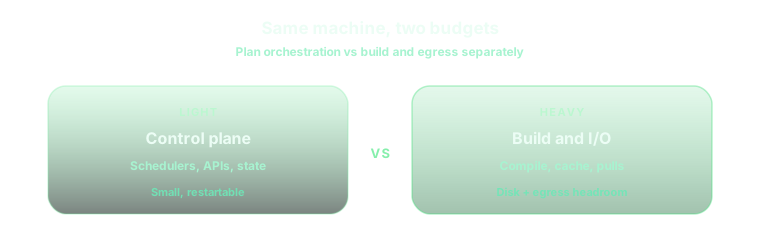
vpszap providesdedicated physical Mac miniswith region-based outbound routing. When running OpenClaw on an instance, it's recommended to separatethe lightweight control planeandheavy workloads: keep the orchestration layer lean; reserve enough disk and bandwidth for build and I/O-intensive steps.
1. Instances, Regions & Bandwidth
If OpenClaw frequently pulls artifacts or calls external APIs, choose a region close to your users or dependencies (Singapore, Tokyo, Seoul, Hong Kong, US West, etc. — see the console for available options). On thepricing pageconfirm that your bandwidth tier can absorb bursts and avoid "build peaks saturating outbound bandwidth."
2. Storage & Persistence
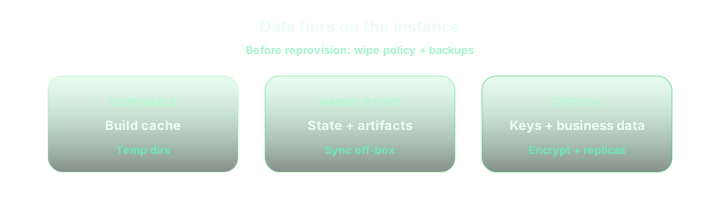
Place state, cache, and build artifacts underwell-defined data volume paths, and sync them regularly to object storage or a private registry. Before rebuilding or migrating, confirm thewipe policywith the console and support team to avoid accidentally deleting unsynced data.
3. SSH, VNC & Unattended Operation
Uselaunchdfor long-running services;VNCreserve VNC for manual troubleshooting. If power operations in the console go through a support ticket or maintenance window, design OpenClaw withgraceful shutdownin mind (flush in-flight tasks to disk or forward them) to minimize hard-cutoff interruptions.

4. Observability, Alerts & Support Communication
At minimum, log exit codes and host CPU, memory, and disk metrics. When contacting support, includetimestamps, log excerpts, and reproduction steps— this is far more useful than "it's sometimes slow." For routine operations, you can also refer toHelp Center.
5. Aligning with Billing Cycles
Daily/weekly instances are better suited forshort burst tasks or peak-hour overflow; if a critical path must run continuously across renewal boundaries, evaluate in advance whether to switch to a longer billing cycle or split the task to avoid interruption at the expiration boundary.
6. Self-Check Checklist
- Have you tested your selected region with areal pipelinefor latency, rather than just looking at a map?
- Do logs and DerivedData each have their owncleanup policy?
- Is the launchd crash restart configured with alimited retry countto prevent infinite loops?
- Do you have astandard log template?
To integrate similar capabilities into a CI or automation pipeline, refer toHelp Centerfor documentation related to runners and scripts; more topics will continue to be published on the developer blog.