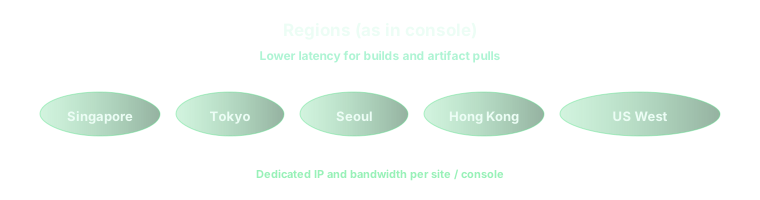
When your product spansSingapore, Tokyo, Seoul, Hong Kong, US East, and US West, a single green build at home is not proof of stability. Performance regressions show up astail latency on cold caches, slower dependency resolution, and different disk pressure once simulators and compilers contend for the same NVMe channel. This FAQ frames how to land across-region performance baseline, what belongs in asmoke gateversus a nightly soak job, and how to read ahardware and rent matrixon dedicatedMac mini M4cloud hosts without over-buying seats or SSD tiers you will not use.

1. Baselines first, then smoke gates
A baseline is afrozen recipe: Xcode toolchain, SwiftPM or CocoaPods resolution mode, DerivedData policy, and whether you warm caches intentionally. Capture wall-clock and I/O-heavy phases (clone, resolve, compile, test bundle, archive) per region after a cold boot. Your smoke gate should replay athin vertical sliceof that recipe — enough to prove routing, signing, and critical paths — while nightly jobs carry variance-heavy suites. Treat baseline drift as a release incident: if Singapore and Virginia diverge beyond an agreed envelope, stop shipping until you know whether the change is network, storage, or toolchain skew.
2. Six-metro placement: what each region is good at testing
Singapore and Hong Kongoften sit closest to APAC API edges and finance-style egress paths — ideal for measuring TLS handshakes to regional services.Tokyo and Seoulstress East Asian CDN splits and language-heavy asset graphs.US East and US Westsplit North American backbone paths and are the usual pair when you must prove both coasts before a Friday cut. You do not need identical suites in every metro; you needpaired representativesthat mirror customer traffic. Run the same smoke binary targets everywhere, but weight longer benchmarks toward metros where you have revenue or latency SLO exposure.

3. Mac mini M4 16GB / 256GB versus 24GB / 512GB for regression detection
The entry16GB / 256GBprofile is enough when smoke jobs are CLI-only, simulators are capped, and you aggressively prune DerivedData between runs. It becomes brittle when you parallelize XCTest bundles, keep multiple runtimes resident, or snapshot large UI tests — memory pressure turns into flaky wall times that masquerade as network regressions.24GB / 512GBbuys headroom for parallel smoke shards and local remote-build caches without constant eviction. If your gate must mirror what developers run on desks, bias upward on RAM before you add a second machine.
4. 1TB / 2TB expansion versus a parallel seat
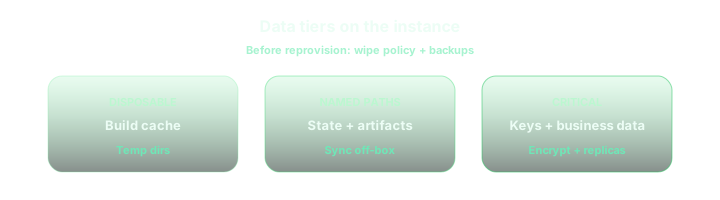
NVMe expansion helps when a single host must retainweeks of Bazel or Gradle outputs, multiple Xcode versions, and fat simulator runtimes. Asecond seathelps when queue depth is the problem: two modest machines finish smoke faster than one oversized disk waiting on CPU. Use a simple matrix: if p95 queue wait exceeds compile time, add a seat; if cache misses dominate after tuning retention, add TB. Cap expansion when your compliance policy still requires periodic wipe — unused terabytes do not lower risk.
5. Short spikes versus mid-term rent when gates multiply
Short daily or weekly bursts fitrelease trainsand experiments where you are still choosing metros. Move to weekly or monthly cycles once smoke plus baseline jobs run on a fixed schedule across multiple regions — switching machines every few days erases the history you need to compare regressions. Quarterly plans make sense when the same hosts also carrylong-lived runner identitiesor persistent caches that would be expensive to rebuild. Align billing length with how long you promise to keep telemetry comparable.
- Store baseline artifacts (logs, trace summaries) withregion and hardware SKU tagsso charts stay apples-to-apples.
- Rotate one metro at a time during upgrades instead of all six at once.
- Fail smoke onrelative slowdownagainst the rolling median, not a single magic number from one laptop.
- Document cold versus warm runs; reviewers should know which mode the gate enforces.
Export the same counters your SRE dashboard already trusts — queue depth, disk utilization, and resolver time — but partition dashboards by metro so on-call can answer “is this Singapore-only?” in one glance. When finance asks why you pay for both US coasts, point to baseline variance: the cost of a silent regression that only reproduces on one path is almost always higher than an extra weekly host.
For runner wiring and Git or artifact placement across metros, see our guide onself-hosted macOS runners in six regions. If remote build caches and enterprise parallel CI are the dominant variable, read theBazel and Gradle remote build FAQbefore you resize disks again.
On vpszap, baselines stay reproducible
The workflows above assumededicated metal, not a noisy neighbor slicing the same SSD. vpszap deliversphysical Mac mini M4hosts with predictable CPU, memory, and NVMe — activated in aboutfive minuteswithSSH and VNCtogether so you can debug flaky gates visually when needed. Plans bill by theday, week, month, or quarterwithno long-term contract, which matches how teams scale smoke fleets around releases instead of locking capital into idle boxes.
If you want these baselines on hardware that behaves like a lab machine in Singapore, Tokyo, Seoul, Hong Kong, or either US coast,vpszap cloud Mac miniis the lowest-friction place to start.