Self-hosted macOS runners on cloud Macs sound simple until you wireGit, private package indexes, and artifact flowsthe same way you would in GitHub-hosted CI — then multiply that bySingapore, Tokyo, Seoul, Hong Kong, US East, and US West. This FAQ explains how to attach credentials safely, when to splitprimary versus followernodes, howMac mini M4RAM and SSD tiers interact with caches, and how to read ashort versus mid-term rentalmatrix when you add parallel runners instead of one overloaded box.

How should Git authenticate on the runner?
Preferscoped credentialsover a single god token. For read-only clones from GitHub, afine-grained PATor deploy key tied to the repository is easier to rotate than a user password. For org-wide access, use a machine account with the narrowest role, store secrets in the Actions secret store or your vault, and inject them at job start — avoid baking tokens into golden images. If you use submodules or private forks, mirror the same policy on each remote so a child repo does not become the weak link. Enable Git LFS only where binaries truly need it; otherwise you pay twice in bandwidth and disk on every warm workspace.
Where do artifacts and package registries land?
actions/upload-artifact and actions/download-artifact still work on self-hosted runners, but disk layout is yours: plan a dedicated volume or folder with quotas so a single workflow cannot fill the boot SSD. For GitHub Packages or GHCR, the job-scoped GITHUB_TOKEN is usually enough for same-repo flows; cross-repo publishing needs an explicit PAT or OIDC trust. External mirrors — npm, PyPI, Maven, Swift Package Manager — should point to regional mirrors when possible so every metro does not crawl the same upstream during peak hours. Pair that with a remote build cache if you run Bazel or Gradle-heavy pipelines; seeBazel and Gradle remote builds on a cloud Mac poolfor cache hit-rate discipline.
Six-region layout: primary versus follower nodes
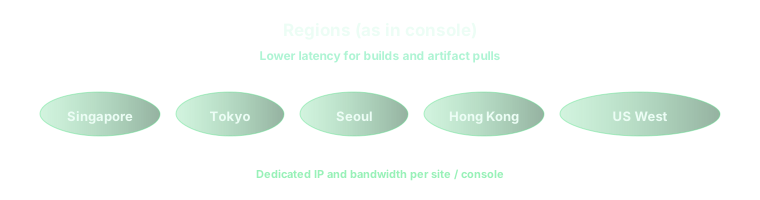
Pick oneprimarymetro per business unit — typically closest to your artifact origin or Git remote — and treat other regions asfollowersthat reuse cached dependencies and binaries. The primary hosts authoritative warm workspaces, long-lived caches, and heavier packaging steps; followers focus on compile-and-test close to developers. US East and US West should not fight the same global queue: shard workflows by product line or timezone instead of round-robin across coasts. APAC pairs (for example Singapore plus Tokyo) benefit from the same rule: align nightly heavy jobs with the region that already holds the largest artifact cache. For seat rotation and queue naming conventions across these six metros, readcross-border seat rotation and parallel queue design.

Mac mini M4 tiers, 1TB/2TB expansion, and parallel runners
16GB RAM with 256GB SSDfits lean Xcode smoke jobs and small SPM graphs when caches stay hot.24GB with 512GBis the safer default when simulators, indexing, and Docker-style sidecars share the same machine. Add1TB or 2TB NVMewhen remote caches, DerivedData, and container layers routinely exceed a few hundred gigabytes — thrashing SSD not only slows builds, it invalidates cost savings from cheaper rent. Parallel runners on two modest Mac minis often beat one maxed machine because queue isolation limits noisy-neighbor disk contention; size each runner so a single job still leaves headroom for the Actions agent and system services.
Short versus mid-term rent: a practical decision matrix
Useshort daily or weeklywindows when you are proving a new workflow, spiking release candidates, or onboarding a contractor fleet — you trade a higher unit price for flexibility. Move the same footprint tomonthly or quarterlywhen cache warm-up time, runner labels, and firewall rules stabilize, because repeated reprovisioning burns engineering hours. If parallel runners share caches, align rental length with cache TTL: mid-term rent pays off once you stop cold-starting multi-hundred-gigabyte workspaces every week. Document expected minutes saved per build; finance teams accept hardware math when it is tied to queue time, not slogans.
- Does every region need a full mirror of artifacts, or can followers pull from the primary cache over a private link?
- Are Git credentials rotated automatically when a runner image is replaced?
- Will two 16GB runners outperform one 24GB box for your mix of compile versus link steps?
- Does SSD headroom cover worst-case weekly peaks without triggering emergency cleanup scripts?
On vpszap cloud hardware, this is easier to operate
Everything above assumes you control adedicated physical Mac miniwith predictable CPU, RAM, and NVMe — not a noisy slice where disk latency spikes when a neighbor runs ffmpeg. vpszap deliversApple Silicon M4machines withSSH and VNCin about five minutes, billed by theday, week, month, or quarterwithno long-term contract, across the samemulti-region footprintyour runners already care about. You can park long-lived caches on one node, wire Git and registries once, then clone the pattern to followers without renegotiating a data-center lease.
If you want this playbook on hardware that feels like a lab machine under your desk — but lives next to your users — start from thevpszap cloud Mac mini homepage.