When engineers sit inSingapore, Tokyo, Seoul, Hong Kong, US East, and US Westat the same time, “one shared Mac in the closet” stops working. This FAQ frames how to designseat rotation(who gets an interactive cloud Mac when), how to runparallel build queueswithout turning every region into a snowflake, and how to pickMac mini M4RAM and SSD tiers — including1TB or 2TBexpansion — while your finance team asks whether spikes should stay onshort daily or weekly rentor roll intomid-term monthly or quarterlybaselines.

1. Seat rotation: named desks versus hot seats across time zones
Named seatsgive each lead a predictable host, which security likes, but you pay for idle nights.Hot seatsreuse one machine across APAC morning and US evening if hand-offs and disk hygiene are enforced. A practical hybrid isone named “golden” Mac per major geographyfor release officers, with the rest pooled behind a booking calendar. Document who may keep DerivedData, who must wipe after logout, and how VPN routing differs when someone jumps from Tokyo to US West the same day.
2. Parallel queues: global FIFO is usually the wrong abstraction
A single global queue looks fair on paper but amplifies latency when a heavy job blocks the only runner near Seoul. Modelone logical queue per regionwhere work has data gravity — artifacts, registries, VPN paths — plus asmall overflow lanethat borrows neighbor capacity when local depth crosses a threshold. Tag jobs withregion=singapore, pin runners to matching labels, and let release trains escalate priority only after they prove they cannot finish locally. If you run long-lived gateways or agents, read how resident hardware compares to multi-region cloud Macs before pinning them to one box.
Learn more: OpenClaw Gateway in 2026 — buy a Mac vs multi-region cloud Mac FAQ.
3. Six-region rapid provisioning: standardize the “happy path”
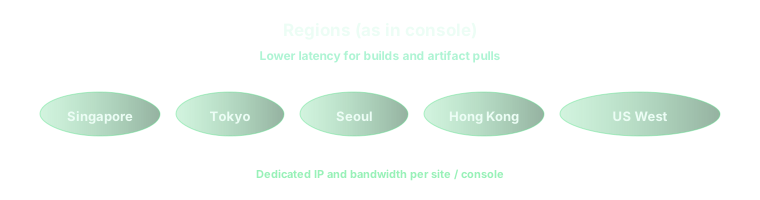
Fast activation acrossSingapore, Japan, Korea, Hong Kong, US East, and US Westbreaks down when every office orders a different Xcode baseline or disk layout. Publish asingle reference image checklist: minimum macOS version, allowed VPN clients, where caches live, and which ports must be open. Provision pairs of hosts in each metro you truly use — one for experiments, one for production-shaped workloads — instead of scattering single machines that nobody can reproduce. Latency and disk topology still beat guessing; the companion FAQ on region picks and NVMe headroom walks through the measurements that should precede any fleet-wide order. Learn more: six-region cloud Mac vs Mac mini M4 latency, storage, and rental FAQ.
4. Mac mini M4 tiers: 16GB / 256GB versus 24GB / 512GB
The16GB RAM / 256GB SSDprofile fits lean pipelines, focused agents, and teams that aggressively prune caches. It frays when multiple Simulator profiles, local language models, and Docker volumes share one host during overlap hours across regions.24GB / 512GBgives realistic headroom for parallel test shards, larger monorepos, and “someone always has Xcode indexing” while another job runs. If your queue depth grows because jobs wait for memory or disk, throwing more concurrency at a 16GB host usually increases flakes; upgrading one tier often stabilizes more jobs than adding a third region nobody measures.
5. 1TB and 2TB expansion: when disk stops being a rotating incident
Cross-border teams accumulateduplicate cachesbecause each site mirrors dependencies “just to be safe.” Even good hygiene leaves Xcode betas, container layers, and Bazel output bases fighting for the same NVMe. When engineers spend stand-up time debating what to delete, budget1TB or 2TBexpansion on the hosts that run the widest mix of jobs — not on every idle sandbox. Pair larger disks withqueue rulesso long-running archives cannot starve interactive seats during business hours.
6. Short-term spikes versus mid-term rent volatility
Daily or weeklyrentals absorb release spikes and region proofs before you move payroll.Monthly or quarterlycycles reward stable caches and fewer reprovisioning tickets. Volatility usually comes from mixing the two without a policy: finance sees a spike, downgrades mid-sprint, and SRE spends a week warming caches again. Align billing cadence with how long credentials and caches may live, then resize RAM and SSD together — not one knob at a time.
7. Steering-committee checklist
- Have you definednamed versus hotseats and documented hand-off rules per region?
- Does each metro have its ownrunner label and queue depth alert, or are jobs still “any Mac”?
- Will16GB / 256GBhosts survive realistic overlap, or do measurements already show swap during peak hours?
- Is1TB or 2TBreserved for shared CI hubs while smaller disks stay on short-lived experiments?
- Does finance understand why amid-termbaseline plus occasionalshort-termburst beats constant churn?
On vpszap, rotation and queues sit on real metal
Seat models and queue sharding only help if the machines underneath behave like predictable Macs, not oversubscribed guests. vpszap deliversdedicated physical Mac mini (Apple Silicon M4)hosts withSSH and VNCin aboutfive minutes, billed by theday, week, month, or quarterwithno long-term contract, across metros that includeSingapore, Tokyo, Seoul, Hong Kong, US West, and US East. You keep full CPU, GPU, and NVMe for your instance — no hypervisor lottery — which makes parallel queues and per-region baselines far easier to reason about than shared “macOS slices.”
If you want this playbook on hardware that matches Apple’s reference environment, start from thevpszap cloud Mac mini homepage.
