As iOS development matures in 2026, the bottleneck for most teams isn't the code—it's the build pipeline. While Apple's Xcode Cloud offers a seamless entry point, scaling teams often find themselves hitting walls in terms of build speed, cost transparency, and environment control. Whether you're a solo indie developer or an enterprise mobile team, finding the best Xcode Cloud alternative for your iOS CI/CD workflow is critical for maintaining high velocity. This guide compares top alternatives, focusing on the massive performance leap offered by self-hosted Apple Silicon infrastructure.

1. The Current State of iOS CI/CD (2026)
The landscape of iOS CI/CD has shifted dramatically since the introduction of Apple Silicon. Building for iOS, iPadOS, and macOS now requires hardware that can handle modern Xcode features like Swift Macros, massive SwiftUI previews, and complex visionOS targets. Xcode Cloud, being Apple's native solution, is the default choice, but its "black box" nature often leads to frustration when builds fail due to environment mismatches or when the limited compute hours become a financial burden.
In 2026, developers are increasingly looking for ios ci cd solutions that offer more than just a "green checkmark." They need deterministic build times, deep cache control, and the ability to run UI tests on real-world simulators without waiting in a queue.
2. Why Look for Xcode Cloud Alternatives?
Xcode Cloud is excellent for simple projects, but several factors drive teams toward alternatives:
- Build Speed: Shared infrastructure often lacks the "raw power" of a dedicated M4 Mac mini. Build times can vary based on platform load.
- Customization: If your project requires custom homebrew packages, specific ruby versions for Fastlane, or complex sidecar services (like a local database for integration tests), Xcode Cloud's sandboxed environment can be restrictive.
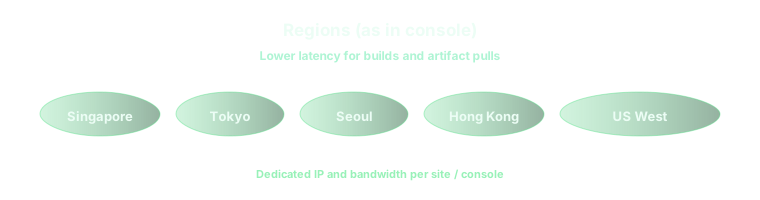
- Regional Latency: For teams in Asia or Europe, connecting to US-centric cloud builders can add minutes of overhead to artifact uploads and downloads.
- Cost at Scale: As your team grows, the per-hour cost of managed cloud services often exceeds the cost of renting dedicated physical Mac mini hardware.
3. The Power of Self-Hosted Mac Runners
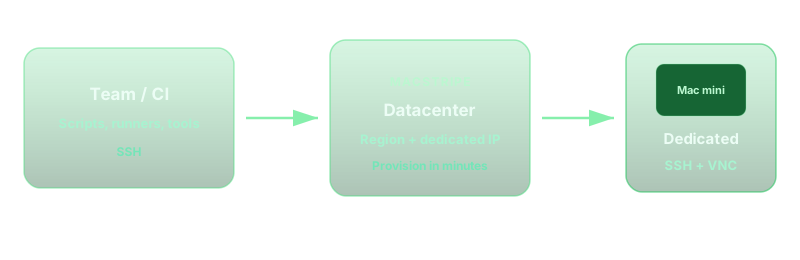
A self hosted mac runner is the gold standard for high-performance iOS CI/CD. By using a platform like GitHub Actions, GitLab CI, or Jenkins with your own dedicated Mac hardware, you gain absolute control. With Apple Silicon (M1 through M4), the performance gap between a shared virtualized instance and a bare-metal Mac mini is staggering.
When you use a self-hosted runner on a dedicated Mac mini, you can leverage persistent build caches (DerivedData) across runs. Unlike ephemeral cloud environments that start "cold" every time, a dedicated runner can slash build times by 50-80% through intelligent caching and superior I/O throughput.
4. Top Alternatives to Xcode Cloud
A. GitHub Actions + Self-Hosted Runners
This is arguably the most popular setup in 2026. You keep your workflow YAMLs in GitHub but point the "runs-on" tag to your own Mac mini cluster. This gives you the GitHub UI you love with the speed of local hardware.
B. Bitrise
Bitrise remains a strong contender for mobile-first CI/CD. They offer specialized "Gen2" Apple Silicon instances. However, for the highest performance, many teams now use Bitrise's orchestration with their own runner nodes.
C. Codemagic
Excellent for Flutter and React Native teams. Codemagic provides great Apple Silicon support, but like Bitrise, it operates on a "pay-per-minute" model which can become unpredictable for large teams.
D. Appcircle
A full-lifecycle mobile DevOps platform. It excels in distribution and enterprise features, making it a great alternative for teams that need more than just a build server.
5. Decision Matrix: Choosing Your Path
How do you decide which infrastructure is right for your iOS CI/CD?
| Feature | Xcode Cloud | Managed SaaS (Bitrise) | Self-Hosted (Vpszap) |
|---|---|---|---|
| Setup Ease | Instant | Medium | Advanced |
| Performance | Variable | High | Extreme (Bare Metal) |
| Customization | Low | High | Absolute |
| Data Sovereignty | Apple Cloud | Provider Cloud | Dedicated Machine |
6. Practical Steps: Setting Up a High-Speed Runner
If you decide to go the self hosted mac runner route using a dedicated Mac mini from a provider like vpszap, the steps are straightforward:
- Provision: Get a dedicated M4 Mac mini in a region close to your developers. See our guide on securing your build gateway with Tailscale or SSH.
- Environment: Install Xcode, Homebrew, and Fastlane. Use tools like
miseorasdfto manage versions. - Agent: Download the GitHub/GitLab runner agent.
- Optimize: Set up a persistent
DerivedDatalocation to maximize cache hits.
7. When Xcode Cloud Still Makes Sense
While alternatives offer more power, Xcode Cloud isn't "dead." It remains the best choice for:
- Small apps with simple dependencies.
- Teams that don't have DevOps resources to manage runners.
- Projects that strictly adhere to Apple's standard project structure without any external tool requirements.
Supercharge Your iOS Pipeline with vpszap
At vpszap, we've optimized our infrastructure specifically for the xcode cloud alternative use case. By providing dedicated physical M4 and M4 Pro Mac minis across global regions, we ensure your CI runners are never bottlenecked by virtualization overhead or noisy neighbors. Our nodes in Singapore, Tokyo, and US West allow you to place your build server where it matters most, reducing the latency of large .ipa uploads. With daily billing and no long-term contracts, you can scale your build farm up or down based on your project's release cycle.
Ready to upgrade your iOS build pipeline? vpszap Cloud Mac infrastructure provides the raw power of bare-metal Apple Silicon combined with the flexibility of the cloud.
