When Tokyo QA, Singapore release engineering, and US East marketing builds all needthe same bundle signed the same way, the bottleneck is rarely Xcode itself. It iswho holds the distribution certificate, howprovisioning profilesflow across regions, and whether each cloud Mac is a disposable runner or a governed signing surface. This FAQ frames six metros—Singapore, Japan (Tokyo), Korea (Seoul), Hong Kong, US East, and US West—as interchangeable capacity only after you standardize profiles, key material, and rental economics onMac mini M4tiers.
1. Why parallel integration breaks without explicit signing governance
Apple’s model assumesone team ID, controlled devices, and predictable entitlements. Multi-region parallel work addsephemeral hosts: each new cloud Mac is a fresh keychain unless you automate import. If Singapore runs Fastlane Match while US East still mounts ad-hoc.p12files, you get drift—profiles expire silently, capabilities differ, and TestFlight uploads fail with opaqueITMS-90xxxerrors. Treat signing aspolicy plus automation: a single source for certificates and profiles (Match, cloud KMS, or your own secret store), short-lived CI tokens, and a documented “which runner class may sign release vs internal” matrix. Pair that mindset with regional queue design so APAC night jobs do not contend with US morning releases—seecross-border seat rotation and parallel queuesfor the operational pattern.
2. Switching metros: make region hops boring
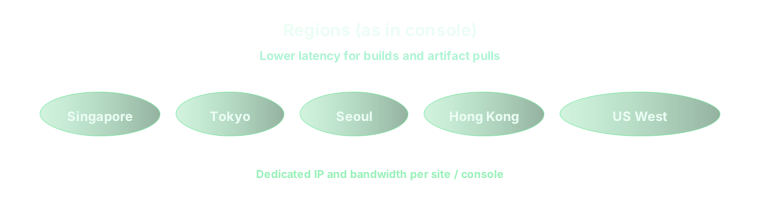
Pick aprimary signing regionclosest to whoever owns App Store Connect changes, then placecompile-and-testhosts where latency to Git and simulators matters. Singapore and Hong Kong suit many APAC HQs; Tokyo and Seoul reduce RTT for Japan- and Korea-facing storefront checks; US East and US West split US traffic without forcing a single coast to own every artifact mirror. The “easy switch” recipe is the same everywhere:identical Xcode minor versionsper branch, scripted keychain setup, cached DerivedData on fast NVMe, andprofile refreshbefore each release train. When StoreKit or regional pricing validation is on the critical path, align hosts with storefront geography—ourApp Store sandbox regional testing FAQwalks through that pairing.

3. Mac mini M4 16GB / 256GB vs 24GB / 512GB
16GB / 256GBfits lean CI: one active Xcode, modest DerivedData retention, and signing-only runners that stream binaries off object storage.24GB / 512GBpays off when you parallelize simulators, keep multiple Xcode betas, or hold large dSYM and bitcode-era artifacts locally. RAM prevents swap during peakxcodebuild archive; SSD prevents profile-and-cache churn from turning into minutes lost per build. If you routinely exceed 200GB of working set, jumping tiers beats endlessrm -rfscripts.
4. When 1TB or 2TB expansion beats “just add another small Mac”
NVMe expansion is the lever whencache localitywins: monorepos, heavy SPM resolve, or teams that refuse remote DerivedData. A single1TB or 2TBhost can amortize storage across sequential release waves; two smaller Macs win when you needtrue isolation(different Apple IDs, different keychains, or compliance boundaries). Cost-wise, compare monthly rent plus engineer wait time—if queue depth spikes weekly, parallel seats often beat one oversized disk.
5. Parallel seats vs one host: a short decision matrix
Parallel seats(several dedicated Mac minis): lower collision risk, simpler per-branch keychain, easier “this runner is release-only.”Single large host: less orchestration overhead, better for interactive debugging, worse if one bad job fills disk. For signing specifically, prefernamed release runnersin one region and fan out compile-only nodes elsewhere.
Short-term rent(days or weeks) fits certificate-rotation drills, one-off major OS upgrades, or a release freeze where you burst capacity.Mid-term rent(monthly or quarterly) wins when the same profiles land every sprint and your queue never idles to zero—spreading seat cost across four to twelve weeks usually beats chaining daily renewals. Match cadence to how often profiles rotate and how long DerivedData caches stay warm.
6. Pre-flight checklist
- Team ID, bundle IDs, and entitlements match across every metro’s export options.
- CI imports the same Match branch or secret version before
gymorxcodebuild -exportArchive. - Apple intermediate certificates and WWDR updates are scripted, not manual clicks.
- Disk headroom exceeds your largest archive plus symbol outputs; watch
tmutil thinlocalsnapshotsif Time Machine is on. - Each region has a smoke job that signs a throwaway IPA and verifies upload credentials.
On vpszap, this stays boring—in a good way
Everything above assumesdedicated metalwith predictable disk and no noisy neighbors. vpszap deliversphysical M4 Mac miniinstances—no virtualization layer chewing CPU—activated in aboutfive minuteswithSSH and VNCtogether so you can fix keychain prompts when automation misses an edge case. Billing is byday, week, month, or quarterwithno long-term contract, which matches how signing fleets spike around release week then cool off. Nodes span APAC and both US coasts so you can park signing next to App Store Connect operators and builds next to your Git monorepo mirror.
If you want that combination on hardware that feels like a desk Mac,vpszap cloud Mac miniis the practical place to start.