An OpenClaw gateway can look“online”while still failing operators: the process is up, the port answers, yet messages never land where you expect, or pairing succeeds while tool calls time out. This FAQ gives acontrast checklist—log forensics first, thenchannels status --probe, thenhealth --json—so you decide whether a restart is justified instead ofblindly bouncing launchdor rebooting a rented Mac mini in another timezone.
1. Define “fake online” before you touch anything
Treatfake onlineas a mismatch between surface signals and outcomes: the dashboard or health probe says green, but channels do not deliver, tokens rotate without clients reconnecting, or sub-agents stall behind a saturated queue. Write down theexpected path(which channel, which workspace, which upstream API) and theobserved symptom(silent drop, 401 loop, WebSocket close, partial JSON). That single sentence becomes your anchor when log lines scroll by. If you are tightening permissions or fan-out limits, cross-check the guardrails inOpenClaw in 2026: Tool Whitelist & Sub-Agent Parallelism — tools.profile, sessions_spawn, maxSpawnDepth Troubleshooting, Minimal-Permission Templates, Multi-Region Mac mini M4 Long-Job Fan-Out FAQbefore you blame the network.
2. Log forensics: what to capture in order
Start withtimestamps aligned to UTCand three bundles: (1) gateway stdout/stderr or launchd output around the incident window; (2) reverse-proxy or Tailscale logs if you terminate TLS or Serve in front; (3) client-side pairing or CLI transcripts. Highlight lines that showreconnect storms,token refresh, orchannel attach/detach. On shared cloud Macs, correlate with other tenants only when you truly share the host—on adedicated Mac mini M4, noisy neighbors are off the table, so treat spikes as your own automation or cron. If the failure spans regions, compare the same five minutes of logs from two metros; asymmetric errors usually mean DNS, egress policy, or a stale config file—not RAM pressure.
Before you truncate or rotate files away, snapshotdisk usageand any launchd throttle messages; “fake online” often pairs with log volume exploding after a debug flag was left on. If you run agents under different UIDs, confirm which user owns the gateway plist—mixing brew-installed Node for one account with a daemon running as another is a classic source of half-working upgrades that still print a cheerful banner at login.
3. channels status --probe: prove reachability, not vibes
Runchannels status --probewhen you need anactive handshakerather than cached state. A probe that fails immediately is a gift: it narrows the blast radius to that adapter or credential. If probes flap only from certain offices, capture whether split tunneling or captive portals intercept WebSockets. When probes pass yet messages still vanish, move on—your transport is probably fine and you should inspectrouting tables inside OpenClaw(which profile, which model route, which workspace binding). Teams rotating seats across borders should align queue semantics with2026 Cross-Border Teams: Cloud Mac Seat Rotation and Parallel Queue Design — Six Regions, Mac mini M4 16GB/256 vs 24GB/512, 1TB/2TB Expansion, and Short vs Mid-Term Rental FAQso parallel operators do not stampede the same channel.
4. health --json vs blind restart: a simple decision matrix
Parsinghealth --jsongives you structured fields for dependencies—Node version, disk headroom, optional daemons—without parsing prose meant for humans. Use it when automation needs a pass/fail gate in CI. Choose aservice restartwhen health shows a wedged subprocess but the host is otherwise sound. Choose afull rebootonly when macOS networking or file handles are clearly poisoned (repeated bind failures, unrecoverable VPN state). Skip reboots when JSON showsconfiguration drift; fix the file, reload, and re-probe. If the symptom is purely economic—deciding whether to rent another week versus buying metal—map costs using2026 Xcode Cloud vs Six-Region Dedicated Cloud Mac: Cost-Effectiveness for Test & CI — Singapore, Japan, Korea, Hong Kong, US East & West; Mac mini M4 (16GB/256, 24GB/512), 1TB/2TB Expansion & Parallel Resources — Short vs Mid-Term Decision Matrix FAQas a finance-friendly companion read.
- Probe fails, health JSON red on that adapter:fix credentials or network path first.
- Probe passes, health yellow on disk:trim caches or expand NVMe before blaming OpenClaw.
- Probe passes, health green, users unhappy:inspect routing, quotas, and upstream APIs—not reboots.
5. Six-region quick-start and rental patterns (2026)
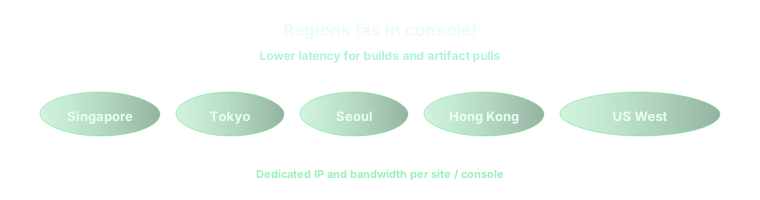
These arefield-shaped examples, not promises of a single SKU: align the metro to where your operators and SaaS control planes live.Singapore or Hong Kongsuits ASEAN plus finance-heavy egress policies.Tokyo or Seoulanchors East Asia latency without crossing the Pacific for every hop.US East and US Westsplit North American users and keep Git and artifact mirrors domestic. Short-term rentals (days to a few weeks) work well for spike reviews and incident war rooms; mid-term (one to three months) fits gateway burn-in next to CI. Provision closest first, then clone your golden image to a second region only after probes succeed—chasing six metros on day zero creates fake progress, not resilience.
On vpszap’s cloud, this playbook is easier
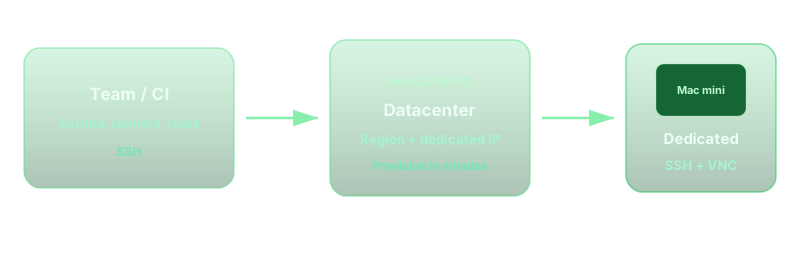
Every step above assumes you can SSH in, read truthful logs, and reboot without a ticket storm. vpszap gives you aphysical M4 Mac mini—no virtualization, no shared CPU or SSD—withabout five minutesfrom payment to SSH and VNC credentials, billed by theday, week, month, or quarterwithno long-term contract. Nodes coverSingapore, Tokyo, Seoul, Hong Kong, US East, and US West, so your gateway sits next to the people who actually operate it. If you want to run OpenClaw on hardware that behaves like a desk Mac, not an oversubscribed VM,vpszap’s dedicated cloud Mac miniis the most direct place to start.
