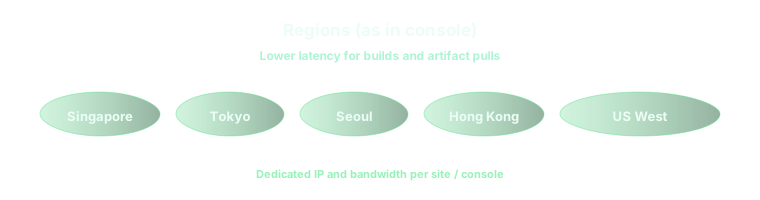
In 2026, most OpenClaw outages are not mysterious compiler bugs: they aremodel routing surprises,provider credential drift, andgateways running in the wrong metrorelative to the people and CI jobs they serve. This FAQ explains how to keep multi-provider setups boringly reliable: pick conservative model pairs, express primary and backup routes inopenclaw.json, wire auth the same way on the CLI host and the resident gateway, then place each gateway on adedicated Mac mini M4 cloud Macclose to its audience across Singapore, Tokyo, Seoul, Hong Kong, US West, and US East.

1. Model matrix: fewer surprises than “latest and greatest”
When you attach more than one LLM vendor, stability comes fromnarrowing the surface area. Pick oneprimary reasoning modelper workload class (interactive chat, long-running agents, cheap triage) and freeze minor versions long enough to regression-test tool calls. Add asecondary vendoronly after you have rate-limit telemetry: if your graph fans out macOS work, the bottleneck is often queue depth and disk, not raw tokens. Document which profiles require JSON mode or strict tool schemas, because fallback models that silently change output shape are how Friday-night pages start.
2. openclaw.json: primary, backup, and honest timeouts
Youropenclaw.jsonshould read like an SLO document. Define thedefault provider and model, then listordered fallbacksper channel or agent profile, each with explicittimeouts and concurrency capsso a wedged upstream does not stall the entire gateway process. Keep provider-specific knobs (base URLs, organization IDs, fine-tuned endpoints) namespaced so you can diff configs between staging and production. Where possible, load secrets from the macOS keychain or a single secrets file the gateway user owns — not from half a dozen shell profiles that differ between interactive login andlaunchdsessions.
Add a short comment block (or internal README link) describingretry and backoff policy: how many times the gateway may hop from primary to backup within a single user-visible request, and when to fail fast instead of amplifying outages. Teams that skip this paragraph usually discover it at 2 a.m. when a vendor incident turns their generous “retry forever” defaults into a self-DDoS of queued tool calls.
3. Auth: install once, validate everywhere
Install the CLI and gateway from thesame release channel, then run your project’s health checks before you expose a port. After upgrades, re-verify thattokens, API keys, and OAuth refresh flowsvisible to the CLI match what the gateway daemon reads; mismatches here masquerade as “random 401s.” If you run bare metal rather than containers, pay special attention to environment parity across Terminal, non-interactive SSH, and user agents — that class of drift is covered in more depth alongside port18789checks in our companion walkthrough. Learn more: OpenClaw bare-metal gateway, port 18789 & auth drift
4. Multi-region Mac mini M4 gateways: follow the control plane
For distributed teams, placeone resident gateway per regionthat actually receives traffic, sized like any other always-on macOS service: enough RAM for concurrent sessions, enough NVMe for logs and local caches, and outbound paths to your model vendors that you have measured — not guessed — from that metro. Align this with your wider cloud Mac strategy: compare APAC versus US East and US West RTT, disk tiers, and when to add NVMe expansion versus another seat. Read: six-region Mac mini M4 latency and rental FAQ

5. Troubleshooting checklist before you open a ticket
Walk this list in order when channels look “flaky” but macOS itself is fine:
- Does
openclaw doctorreport the same CLI and gateway versions you think you deployed? - Are primary and backup models reachable fromthis region’segress IP, with quotas intact?
- Did a profile switch tools or spawn depth in a way that now trips provider-side safety filters?
- Are logs rotating cleanly, or is a full disk slowing TLS handshakes and token refresh?
On vpszap’s cloud, this stays boring in a good way
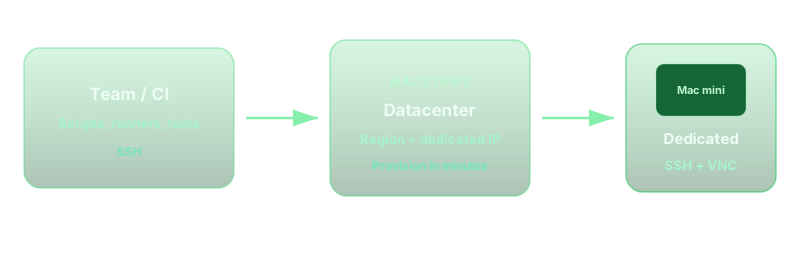
Everything above assumes you can SSH to areal Apple Silicon Macthat does not share CPU or SSD with strangers. vpszap rentsphysical Mac mini M4machines withno virtualization layer, typically online in aboutfive minuteswith bothSSH and VNC, billed by theday, week, month, or quarterwithout a long-term contract. That combination matters when a gateway must stay up overnight, hold large local caches, and sit in the same metro as your users across APAC and both US coasts.
If you want to run OpenClaw the way this FAQ describes — predictable hardware, predictable networking — start from vpszap’s cloud Mac mini home page and pick the region that matches your real control-plane map.