Aresident OpenClaw gatewayon bare-metal macOS is the opposite of “run it in Compose and forget the host.” You inheritlaunchd, login sessions, GUI-less LaunchAgents, and every subtle difference between what you typed in an interactive shell and what the daemon actually sees. This FAQ walks alayered troubleshooting order—process identity, environment parity,TCP port 18789, then auth state after upgrades—contrasted with the Docker path where env and tokens tend to live in the compose file. It closes with amulti-region M4 cloud Macfailover pattern so APAC and US teams can rehearse a real cutover instead of improvising during an outage.
Bare metal vs Docker: what actually breaks
OnCompose, you pin images, mount a single env file, and health checks usually hit the container’s loopback. OnmacOS metal, the gateway binary may run under a different user than your admin shell, inherit a stripped PATH, or start before the network is fully up. Treat “it works when I ssh in and run it” as a failed gate: reproduce under the same LaunchAgent plist or onboarding command your runbook uses. For image pinning, volume design, and gateway probes in containers, pair this note with our OpenClaw Docker Compose in 2026: deployment and troubleshooting.
Docker also gives you asingle artifactfor “known good” upgrades: digest-pinned pulls roll forward and back symmetrically. Bare-metal upgrades mix OS patches, Homebrew or npm trees, and Apple’s own security updates—any one layer can change dynamic linker paths or notarization behavior. Keep apre-flight snapshot(plist, env file, and a redacted copy of gateway config) in git tagged with the macOS build number so you can diff what changed between Tuesday’s healthy state and Wednesday’s mystery 401s.
launchd: user agents, sessions, and environment parity
Installers often register aLaunchAgentunder the gateway user’s~/Library/LaunchAgents. That process typically does not see your .zshrc exports; it may not see Keychain unlock prompts either. Mirror every required variable into the plist (EnvironmentVariables) or a small wrapper script sourced from a single file under version control. If you also run a Linux relay or worker host, the same discipline maps tosystemd user units(systemctl --user) with explicitEnvironment=lines—macOS itself still uses launchd, but hybrid teams should keep one canonical env file per OS family.
After edits, launchctl bootout then launchctl bootstrap the agent label, then confirm with launchctl print for your domain (replace the label with the one in your plist). Logout/reboot drills matter: many failures only appear on a cold boot when Wi‑Fi or VPN daemons race the gateway.
Port 18789 and local health checks
Teams frequently misread “gateway healthy” as “Node process started.” On a resident host you want aTCP check on port 18789(or the port your release pins in docs) from the same network namespace clients use—nc -vz 127.0.0.1 18789 from the daemon user, not only from root. If something else binds the port, lsof -nP -iTCP:18789 -sTCP:LISTEN surfaces the conflict quickly. When a reverse proxy or mTLS edge terminates in front, document whether health checks should hit the edge or loopback so on-call does not chase the wrong layer.
If you intentionally bind beyond loopback for LAN testers, pair that choice with host firewall rules and a written exception—macOS updates have a habit of resetting assumptions about who can reach a high port from Wi‑Fi guests. Prefer SSH tunnels or a proper edge until you are sure the exposure matches your threat model.
Post-upgrade “auth drift” and token mismatches
Package upgrades rewrite binaries and sometimesrotate default config paths. Symptoms look like sudden 401s or “connected but rejected” in clients even though launchd shows running. Compare the on-disk token or API key your agents send with what the new build expects (OPENCLAW_GATEWAY_TOKEN and friends), and verify you did not leave one copy in the plist and another in a shell-only export. Keychain-backed secrets can desynchronize after major macOS upgrades—re-run the vendor onboarding step that rebinds credentials, then restart the agent. For install-path choices and buy-vs-rent hardware context, see
OpenClaw Gateway in 2026: installer paths, npm, and buy-vs-rent FAQ.
Multi-region M4 cloud Mac failover (FAQ-style)
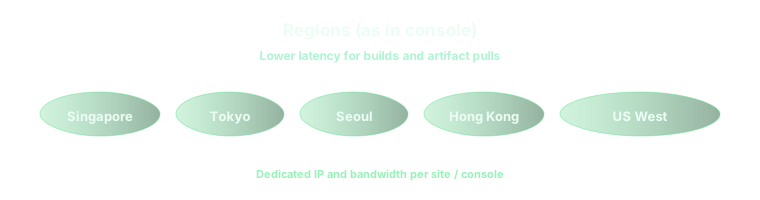
Primary + standby in two metros:Provision identical M4 Mac minis (same RAM/NVMe tier) in, say,Tokyo and Singapore; keep config and tokens mirrored via git-backed env templates. Run synthetic probes from each region’s office VPN toward both gateways; whichever wins RTT becomes primary for that cohort.
Cutover:Lower DNS TTL or use a floating hostname your clients already resolve. Stop the LaunchAgent on the failed side only after traffic drains—avoid split-brain where two gateways accept the same bot identity. Rehearse quarterly with a scripted “stop primary” drill and a wall-clock target (for example, under ten minutes to green).
Observability:Ship stdout/stderr from the LaunchAgent into your existing log stack—bare metal fails silently if you only discover issues when a human opens Console.app. Correlate gateway restarts with Wi‑Fi drops, power events, and macOS minor upgrades; those three explain a surprising share of “random Tuesday” disconnects on deskside Macs and are equally visible ondedicated cloud Macsonce you treat them like production hosts instead of disposable shells.
Parallel queue and seat-rotation patterns for large teams are covered in the cross-border cloud Mac seat rotation and parallel queues FAQ; the gateway-specific lesson here is tosize NVMe for logs and local cachethe same way you would beside CI, so failover nodes do not thrash disk during catch-up sync.
One-page ops checklist
- Confirm the LaunchAgent label, user, and working directory match the runbook; cold-boot test after plist changes.
- Diff environment between interactive SSH and plist (
printenvvs logged daemon env). - Prove
127.0.0.1:18789listens as the gateway user; resolve port conflicts before touching app logic. - After every upgrade: verify tokens, config paths, and Keychain-backed secrets; replay one canned client conversation.
- Document regional primary, standby, DNS TTL, and who is allowed to declare failover complete.
On vpszap, resident gateways stay closer to real production
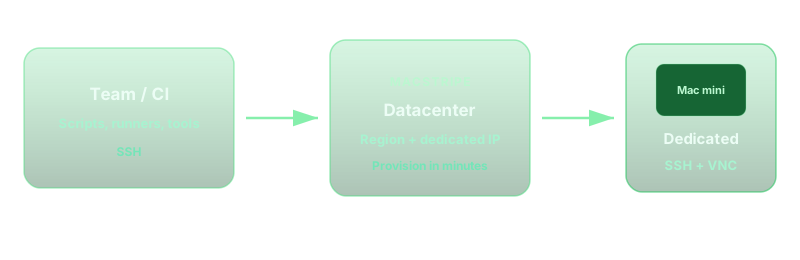
Everything above assumesdedicated Apple Siliconwith predictable disk and no neighbor noise. vpszap offers aphysical M4 Mac mini—no virtualization, the full CPU, RAM, and SSD for your instance—activated in aboutfive minuteswithSSH and VNCtogether, billed by theday, week, month, or quarterwithno long-term contract, acrossmultiple low-latency regions. That is the shape teams use when they want the same bare-metal story in Tokyo and US West without owning two racks.
If you want this gateway checklist on hardware that matches how you run OpenClaw in anger, vpszap cloud Mac mini is the most straightforward place to start.
