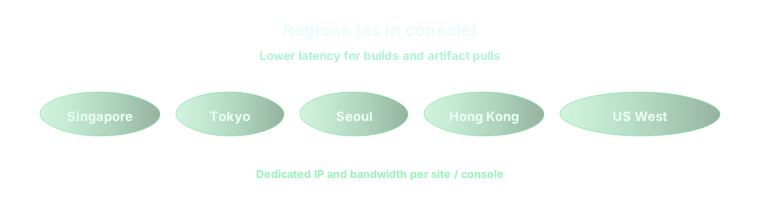
In 2026, OpenClaw failures during upgrades rarely look like exotic compiler errors. They look liketwo binaries answering to the same name,launchdunits still pointing at an old prefix, andgateways upgraded out of orderacross Singapore, Tokyo, Seoul, Hong Kong, US West, and US East. This FAQ covers when to preferopenclaw updateversus re-running the officialinstall.sh, how to survive annpm -ginstall beside a git checkout, what to snapshot before production, and how to grey-route a new gateway while usingopenclaw healthas a sign-off gate your release manager can read without reading Rust.

1. Pick an upgrade spine before you touch a gateway
Stable migrations start with a boring rule:one release channel per host role. For interactive workstations,openclaw updateinside the same prefix you already trust is usually enough if your prioropenclaw doctorwas clean. For servers and resident gateways, many teams prefer tore-run the official install.shfrom a tagged release tarball or pinned URL, because it re-establishes the layout the docs assume — then immediately runopenclaw doctoragain under the same user yourlaunchdjob uses. Mixing “I npm-installed last month” with “today I cloned main” is how you get two different--versionstrings in Terminal versus non-login SSH. Learn more: OpenClaw skills, workspace, and permissions FAQ
2. npm global beside a source checkout: typical pain and the fix
The classic foot-gun isPATH order: Homebrew shims,~/.npm-global/bin, and a developer’s~/src/openclaw/target/releaseall competing. Symptoms include “unknown command flags” after reading new docs, sporadicMODULE_NOT_FOUNDerrors when plugins expect a different package tree, and gateways that log a schema version your CLI cannot parse. Fix it decisively: pickeithernpm globalora source install for that machine class, remove the other from PATH for service accounts, and symlink only if your standards team insists. Keepopenclaw.jsonand secrets under a single OS user per gateway. When tool profiles change across versions, validate allowlists before you blame the model vendor. Learn more: Tool whitelist and spawn-depth FAQ
3. Rollback checklist you can paste into a ticket
Before any production gateway upgrade, snapshot four things:the exact git tag or npm version,your rendered service plist or compose file,a tarball of the active config directory, andthe output of openclaw health from the old build. After a bad deploy, roll back in reverse order: stop the new unit, restore the plist to the prior ProgramArguments path, put the saved binary or container image tag back, restore config, start the old unit, then re-run health and compare textually to your saved capture. If rollback still shows auth errors, suspect environment drift between login and non-login shells rather than “AI flakiness.”
- Capture
openclaw --version,openclaw doctor, andopenclaw healthto a dated log file per region. - Freeze DNS or load-balancer weights until two consecutive health runs succeed on the canary.
- Verify disk headroom — full NVMe makes even honest upgrades look like mystery TLS failures.
- Document who owns
openclaw.jsonmerges so partial edits do not land mid-upgrade.
4. What openclaw health must prove before you promote traffic
Treatopenclaw healthlike a smoke test artifact. Before widening DNS weights, capture:matching CLI and gateway build IDs,provider connectivitywith latency near pre-change logs, anddisk plus launchd sanity. Run it twice — interactive shell and the same user context your daemon uses — and insist both transcripts match; mismatches usually mean PATH, keychain, or env drift after upgrade.
- Attach redacted health output to the change ticket.
- Compare provider error rates on a fixed synthetic prompt batch.
- Re-check tool profiles if policy packs changed — silent denials look like model failures.
5. Multi-region Mac mini M4 grey gateways and staged promotion
For teams spanning APAC and both US coasts, runone canary gateway per metroon a dedicated Mac mini M4 cloud host, shift a small slice of clients or internal bots first, and only promote DNS or Tailscale names afteropenclaw healthmatches your saved baseline on that host. Compare model RTT per region — the same binary can be “healthy” in Virginia and sad in Tokyo if egress differs. Store health output beside your CI build number. If you are tuning model routing too, change one axis at a time. Learn more: Models, openclaw.json failover, and gateway auth FAQ

On vpszap’s cloud, upgrades stay reproducible
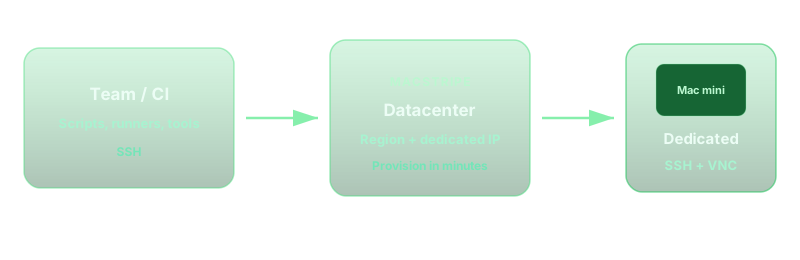
Everything above is easier when every gateway sits on aphysical Mac mini M4withno virtualization layer, the whole CPU and SSD dedicated to your instance, reachable overSSH and VNCwithin aboutfive minutesof provisioning. Plans bill by theday, week, month, or quarterwithno long-term contract, which matches how teams actually iterate on OpenClaw in 2026 — short windows for canaries, longer windows when a metro stays hot. Multi-region low latency is a product feature, but it is also an upgrade strategy: you can rehearse the same install script in Tokyo before you touch production in Virginia.
If you want hardware that does not fight your upgrade checklist, start from vpszap’s cloud Mac mini home page and pick the regions where your real users and runners live.