External TestFlight cohorts surface crashes faster than internal dogfood, but stacks only become readable whendSYM symbolicationlines up with the exact build Apple served testers. When your release train spansSingapore, Japan, Korea, Hong Kong, US East, and US West, the failure mode is rarely “Xcode is slow”—it iswrong region builds, missing UUID archives, and disk pressurefrom parallel betas. This FAQ maps how to split metros, sizeMac mini M4hosts, and choose1TB / 2TBexpansion versus extra concurrent seats across short and mid-term rentals.
1. Pipeline stages that must stay in lockstep
Think in four beats:archive(bitcode off for most teams in 2026, but dSYMs still generated per configuration),uploadto App Store Connect,tester distribution, andcrash rehydrationwhen Organizer or your crash backend pulls logs. Symbolication breaks when the dSYM UUID does not match the executable slice testers ran—often because someone promoted a hotfix built on a different Mac image. Pin onegolden Xcode + SDKper release line, store.xcarchivebundles or exported dSYM folders with the same retention policy as binaries, and never recycle a cloud Mac for another app line without wiping DerivedData. For cohorts that mirror regional App Store behavior, seeLearn more: App Store sandbox and regional testing on six-region cloud Mac.
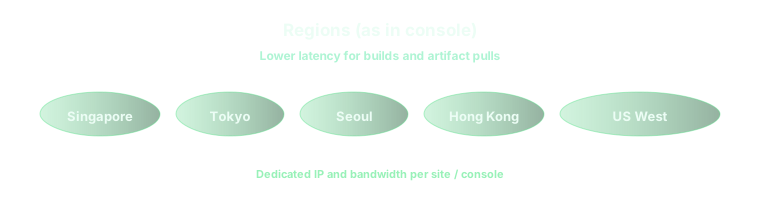
2. How to split Singapore, Tokyo, Seoul, Hong Kong, US East, and US West
Assign regions bywho waits on the machine, not by brand color on a slide.Singapore or Hong Kongworks well as an APAC hub when India + Southeast Asia testers dominate latency-sensitive uploads.Tokyoanchors Japan-heavy cohorts and domestic CDN egress patterns.Seoulpays off when Korean banking or game testers need local last-mile realism.US Eastfits Connect-facing automation and East Coast release managers;US Westpairs with Bay Area CI and late-night hotfix squads. Run two-week pilots: ship the same build from two candidate metros and compare medianTransporter / API upload minutesplus crash download time. Once stable, label each Mac “build-only,” “symbolicate-only,” or “hybrid” so teams do not thrash disk with simulator assets on the host that should stay cold for archives.
3. Mac mini M4 16GB / 256GB versus 24GB / 512GB
16GB / 256GBis enough for single-flight TestFlight automation: one active archive lane, lean DerivedData hygiene, and dSYM upload scripts without local crash databases. Add headroom when you runparallel schemes, UI tests in the same session, or Rosetta-heavy dependencies—those spike memory and scratch IO.24GB / 512GBis the calmer default when engineers VNC in to reproduce tester steps while CI still holds the archive, or when you keep multiple recent builds for regression symbolication. Memory prevents swap duringxcodebuild archive; SSD keeps UUID-indexed dSYM trees searchable. If you are forecasting disk for many slices, readLearn more: Cloud Mac disk headroom, parallel compile forecasting, and six-region tieringbefore you buy more seats than NVMe.
4. 1TB / 2TB expansion versus concurrent seats
NVMe expansion wins whena single trust domainmust retain months of archives for compliance or when crash backfills spike after a major release. Extraconcurrent seats(additional dedicated minis) win when teams collide on Friday cutovers—one host per squad stops accidental DerivedData wipes. Short-term rentals favorburst seats + scripted cleanup: rsync dSYMs to object storage nightly, delete local archives older than N builds, and rotate hosts weekly. Mid-term programs (multi-quarter betas) usually blendone 24GB machine with 1TBfor hybrid work plus a cheaper 16GB node purely for CI uploads. Always separate “dirty” repro Macs from “clean” archive Macs so a simulator cache never evicts the dSYM folder you still need Monday morning.
- TrackUUID coverage: every shipped build ID should map to a folder you can still
atosor import into your crash tool. - Automatepost-archive checksum logsso uploads are auditable across regions.
- Keepnetwork egress budgetsin the same metro as most testers to avoid double-pulling symbols across the Pacific.
5. Short-term versus mid-term rental posture
Two-week spikes around major TestFlight pushes rarely justify buying metal—rentday / weekcycles, freeze images, and tear down when crash volume drops. Mid-term horizons (8–12 weeks of overlapping cohorts) benefit frommonthlyanchors on 24GB hosts with expansion, because re-onboarding Xcode and re-syncing keys costs more than the incremental rent. Whatever horizon you pick, document arunbookper region: who owns signing, where dSYMs land, and which host is allowed to run App Store Connect API keys. That discipline matters more than chasing the last hundred megabytes of SSD.
On vpszap cloud hardware, this stays boring—in a good way
Everything above assumesdedicated Apple Siliconwith predictable disk—not a noisy neighbor slicing the same SSD. vpszap providesphysical M4 Mac minihosts with no virtualization tax, roughlyfive-minute activation, and bothSSH and VNCso release engineers can triage crashes without juggling two vendors. Plans bill byday, week, month, or quarterwith no long-term contract, and nodes span the metros this article references so your TestFlight pipeline can live beside the testers who stress it.
If you want the workflow in this article on hardware that behaves like a machine under your desk—only in Singapore, Tokyo, Seoul, Hong Kong, US East, or US West—start from thevpszap cloud Mac mini homepageand mirror the same image in every region you activate.
