A credible PoC or MVP demo rarely needs a twelve-month hardware plan — but itdoesneed the right macOS environment quickly, in the metro where your reviewers and testers actually sit. This FAQ focuses ontwo-week spikes through roughly two-month MVPson dedicatedMac mini M4hosts acrossSingapore, Japan (Tokyo), Korea (Seoul), Hong Kong, US East, and US West: how to choose a region without analysis paralysis, what16GB / 256GBcovers honestly, when24GB / 512GBplus1TB or 2TBNVMe expansion becomes the cheaper story than fighting queues, and how to compareparallel machineswithphased upgradeson a single box.
1. Pick a metro in one pass (six regions)
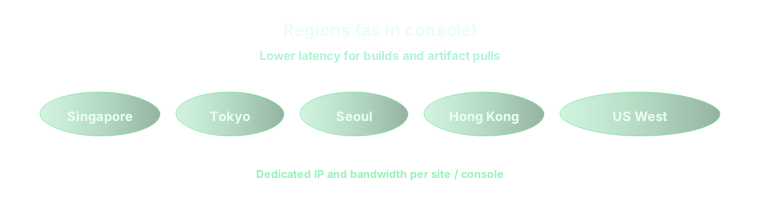
Start fromwho feels latency: TestFlight reviewers inSingapore, partners inTokyo, banking reviewers inHong Kong, QA inSeoul, or US prod mirrors split acrossUS EastandUS West. Have them SSH from real laptops, pull dependencies, launch Simulator — empirical beats maps.
If Git remotes, caches, or signing endpoints concentrate in one hub, park the Mac there even when HQ is elsewhere. Confirm SKUs in theConsolebefore you freeze runbooks.

2. Fast provisioning: two-week spike vs two-month runway
Two-week spikesreward one dedicated Mac, pinned Xcode, scripts in Git, and VNC only for scheduled walk-throughs.Two-month MVPsquietly accumulate binaries, crash captures, and CI experiments — disk graphs bend before CPU does.
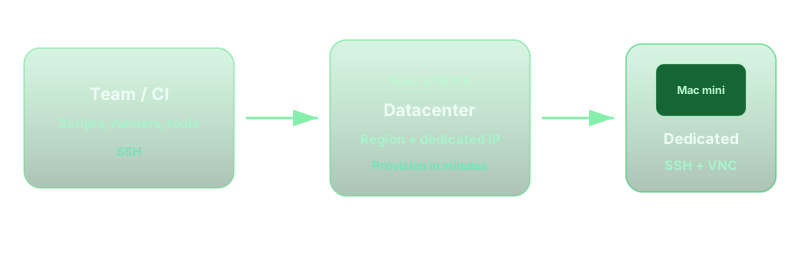
Provisioning stays predictable:tier + metro + billing cadence, checkout, then~5 minutesto SSH/VNC — see the steps below. Short spikes often feel natural onweeklycadences; longer MVPs gravitate tomonthlyorquarterlyto avoid order churn. Reconcile any slide math with the livepricing page.

3. When Mac mini M4 16GB / 256GB is “enough”
The entry tier shines when you operateone primary Xcode workspace, lean CocoaPods or SPM graphs, modest DerivedData hygiene, and demos that serialize builds instead of launching three simultaneous integration suites.256GB SSDremains viable if you aggressively prune old simulators, relocate bulky archives to object storage, and refuse to hoard multiple major Xcode copies unless truly necessary.
Memory-wise,16GBcarries scriptedxcodebuildruns, lightweight Fastlane lanes, and focused Flutter/React Native sessionsas long asyou avoid keeping Slack, Chrome, and two IDEs resident alongside GPU-heavy Simulator piles. The moment weekly spikes turn into overlapping demo rehearsals plus nightly CI, pressure rises faster than CPU percentages imply.
4. Stepping up to 24GB / 512GB and stacking 1TB / 2TB NVMe
Upgrade memory and baseline SSD when you observeswap churn, persistent Xcode indexing stalls, or parallel scheme builds that previously succeeded only because teammates staggered commits.24GB / 512GBbuys headroom for simultaneous profiling sessions, larger SwiftUI previews, and multi-target workspaces without micromanaging quit cycles.
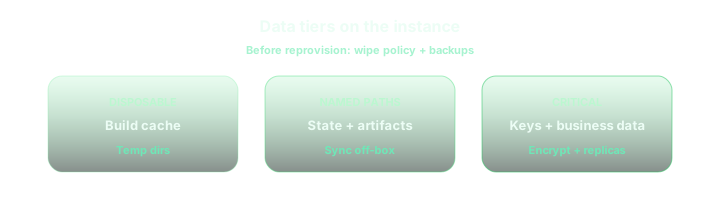
Add1TB or 2TBNVMe expansion when telemetry showsdisk watermark alarmsfrom caches — Docker layers for backend mocks, ML artifact folders, recorded ReplayKit assets, or monorepo artifacts — outpacing how often you can gc safely mid-sprint. Expansion frequently costs less emotional bandwidth than repeatedly re-provisioning slim machines mid-demo-week.
5. Parallel machines vs phased expansion (cost lens)
Parallel dedicated Macshelp when you needisolated blast radius(investor builds versus messy CI), compliance separation, or wall-clock throughput that caching cannot salvage.Phased expansionon one host wins when schedules serialize cleanly and queues stay honest.
Sketchrent × calendar weeks: extra small machines look cheap until duplicated setup and drift steal days; maxing specs on day one hurts if the PoC ends in ten days. Most teamsstart lean near testers, watch disk and RAM for one sprint, then bump tier or NVMe before buying a second Mac.
More depth:six-region latency and Mac mini M4 rental FAQ,disk headroom and parallel runner stacking, andXcode Cloud vs dedicated six-region cloud Mac pricing FAQ.
6. Pre-flight checklist before you wire budget slides
- Did you measureSSH + Git pull + warm buildfrom each candidate metro instead of guessing?
- WillVNC demostraverse your corporate VPN without turning latency into a storyline?
- Do caches (DerivedData, CocoaPods, Gradle if hybrid)fit under chosen SSDwith a two-week safety buffer?
- If MVPs slip beyond thirty days, have you modeledtier bump vs second Macusing live quotes?
Automating beside Xcode?Running OpenClaw on vpszap Cloudcovers SSH/VNC ergonomics PoC teams reuse.
On vpszap cloud, PoCs stay grounded in real hardware
The workflows above assumepredictable Apple Siliconwithout surprise contention — exactly whatdedicated physical Mac mini M4instances deliver: entire CPU, GPU, RAM, and SSD are yours, not hypervisor slices.About five minutes after checkoutyou receive pairedSSH and VNCendpoints, which keeps scripted pipelines and last-minute GUI tweaks on one timeline.
Billing stays aligned with uncertain demo calendars:daily, weekly, monthly, or quarterlycycles andno long-term contractmean you can mirror the shape of a PoC without pretending revenue certainty exists on week two. Six metros across APAC and the United States keep reviewers psychologically close to production latency.
If you want this playbook running on hardware that feels like a desk Mac rather than a brittle VM,vpszap cloud Mac miniremains the pragmatic starting point.